Thursday, October 19, 2006
NLCS Game 7
OH MY FUCKING GOD DID YOU JUST SEE THAT CATCH BY CHAVEZ!!!!!!!!!!!!!!!!!!!!!!!!!!!!!!!!!!!!!!!!!!!!!!!!!!!!!!!!!!!!!!!!!!!!!!!


Wednesday, October 18, 2006
Just a Place
 1.
1980
Wide-eyed Neddie, in Noo Yawk for the second time in his independent life, on a toot from Kenyon, anticipating a wild night with the Psychedelic Furs and the English Beat at the Ritz. I'm with two-three native friends, guys whose dads are nuclear engineers, dentists, road-paving contractors in Larchmont, Islip, Great Neck. They are sooooo jaded. They wear their world-weariness and cynicism like badges on their Goodwill greatcoats, in among their Tin Huey and Wayne County buttons. We're just wandering the Lower East Side in the early evening, killing time before the doors open at the Ritz. Turn a corner on the Bowery and BLAM! There it is! CBGB! OMF(u)G!
"Whoa!" observes your correspondent trenchantly. "CBGB!"
This may have been a tad hayseed of me. I may have betrayed my sheltered upbringing to my ultrasophisticated companions with this awestruck outburst. An eye or two may very well have rolled.
"Come on! I wanna look in! I wanna see!"
"Jesus, Neddie. It's just a place."
"Fuck place! It's CBGB! Come on! I'm going in!"
Nobody came with me.
The place was empty. Nothing was going on. A bartender was unloading cases of beer. A lone, tall figure leaned his back against the bar, plainly blitzed out of his gourd. He rocked from side to side, unable to find his center of gravity. His hair hung down over his face as he contemplated the floor. He appeared to be nodding out and waking again every few seconds.
He was, of course, Joey Ramone.
Back on the sidewalk: "It was Joey fuckin' Ramone! Standing right there! FUBAR! I'm not fuckin' hallucinating, you assholes! He was right there!"
"Right, Ned. Right. Joey Ramone. Let's get some pierogies at Leshko's."
2.
1983
Rent-poor, clothes-poor, food-poor, a year out of college and toiling for a four-figure income, your Ned is domiciled in a roach-ridden, rat-infested first-floor sublet on 28th and Eighth, quickly depleting his record collection at the used-record shop, sacrificed on the Altar of Beer-Money. Didn't exactly have much use for my moth-eaten "Thick as a Brick" and my Mexican pressing of "Let It Be" those days anyway.
Bobby Lightfoot comes down from Hampshire College for a visit. Still only a sophomore, he's got Dreams. Big Dreams. Gonna be a Rock-n-Roll Star, yes sir, Casio keyboard always at the ready to regale us with a newly-worked-out arrangement of Joe Jackson's "Steppin' Out." At great length.
He's not yet formed The Malarians, but the pieces are in place, and it's pretty easy to tell the kid's already in a musical zone way beyond anyplace I've ever been. Ambitous. Very ambitious.
We go downtown. Can't even remember why, now. Our wanderings take us to the Bowery, and when I point out CBGB across the street, his reaction's not dissimilar to mine three years earlier. He wants to check it out.
There's a crowd outside, and we have to squeeze our way through it. I look at Bobby, and almost piss myself laughing. His spine is absolutely straight as me winds around people, his eyes are hooded in the best Punk style, he's pulled himself to his full six feet, and he is actually, swear to God, sucking in his cheeks.
Come on, Bobby! They're just people! You're not going to get discovered in this crowd!
I still rib him about that.
3.
1986
I haven't seen a copy of the Village Voice in years, so I don't know if this is still true, but in the early-mid Eighties the back page always had some mighty amusing little ads. One of these touted a phone number, which, when called, triggered an answering machine that played a little fifteen-second snippet of very odd music -- accordions, synthetic horns, weird percussion, with funny, slapdash lyrics about plumbing, airplanes, and Necco wafers. We loved it, we geekazoid inhabitants of Prospect Place, Brooklyn, and called it regularly, phoning each other when a new tune had been posted up.
It's a little hard to believe, in these days of instant Internet-driven fads, but I'm prepared to argue that They Might Be Giants (for the weird little songs on the answering machine were, in fact, their brainchild) invented Viral Marketing.
Be that as it may, a warm night found me and my great pal Paul at CBGB, taking in a They Might Be Giants gig. We sat at the bar, more or less exactly where Joey Ramone had parked his wasted ass five years before. I was a bit disappointed in TMBG's live act; they were standoffish and shy when they needed to fill the room with their presence, and I was quite put off by the fact that considerably more than half of the music I was hearing was pre-taped.
Paul sloped off to the bathroom. As he left, a voice behind me excused itself, its owner trying to get through the crowd to the bar. As he approached my side, I obligingly shifted my stool a few inches so he could belly up and get the bartender's attention. He thanked me, and we started chatting, as one does at bars.
"What do you think?" he said, pointing his chin at the stage.
"Oh, I dunno... I loved their album, but this playing-with-tapes thing, I don't care for that much..."
"Yeah, I know what you mean, you want value for money, you know -- like, I paid how much to watch a couple of guys playing along to their record player?"
"Yeah, exactly!"
The conversation went on in this vein for a bit longer, comparing who we liked and who sucked. During this time Paul returned and reclaimed his seat. I felt a little explosion when he'd oriented himself, and as my interlocutor said, "Well, my date's waiting, gotta get back to my table. Good talking to you...", I was fending off frantic tugs on my shirt-sleeve.
"What the fuck, Paul?"
"Do you fucking know who that was? Jesus Christ, that was Judd Nelson!"
"Who?"
Nelson had, at the time, just starred in "The Breakfast Club" and "St. Elmo's Fire," and was easily one of the most recognizable faces in America. Today it might be as though I'd just passed five chatty minutes with Vince Vaughn, or perhaps Owen Wilson, without knowing who they were.
Recognizable, that is, except to me. I hated Brat Pack movies, anyway. To me, he was just some guy.
I'll always think of him as My Close and Personal Pal Judd.
Monday, October 16, 2006
But I'm Going Naked, Sonny, in the Morning!

I subscribe to the newsletter of The Rocking Vicar, a very amusing weekly in which contributors reminisce Englishly about their misspent youths in the rock-and-roll trenches. The latest issue features a post from Will Birch, the genius behind late-Seventies power-poppers The Records (peace be upon them), about a device he'd bought at the now-defunct Tower Records in LA, that allowed him to slice open shrinkwrapped LPs -- a minuscule boon, perhaps, but we welcome anything that eases life's tribulations.
Highly recommended stuff.
Another poster contributed the UK Top Ten list of albums from the day he was born, October 8, 1966, and suggests that it may very well rank as the Best-Ever Album Chart:
- Soundtrack: Sound of Music
- Beatles: Revolver
- Walker Brothers: Portrait
- Beach Boys: Pet Sounds
- Spencer Davis Group: Autumn 66
- Various: Stars Charity Fantasia -- Save the Children Fund
- John Mayall/Eric Clapton: Bluesbreakers
- Herb Alpert: Going Places
- Kinks: Well Respected Kinks
- Bob Dylan: Blonde on Blonde
So what were they putting in the water? (Wait, I think I know the answer to that...)
As for Your Humble and Obedient, I find myself still under the spell of the Nuggets II succubus*, still unable to shake the Sixties FreakBeat obsession that's been gibbering squeakily in my ear for all these months. First I feel constrained to try a cover of an obscure Swedish band's attempt at Early-Beatle-iciousness, and now this: "I See the Rain," by The Marmalade.
I was utterly gobsmacked to find out that a pop combo I'd ridiculed a few months ago as having the worst band name in the history of the world actually became The Marmalade in the mid-Sixties. Next you'll be telling me Andy Summers played in Dantalion's Chariot or something.
I think the thing that fascinates me most about the Nuggets II collection is that it proudly touts itself as hit-free. Probably the best-known track in it is Status Quo's "Pictures of Matchstick Men"; otherwise, as far as I know, none of these marvelous curiosities ever cracked a Top Ten in an English-speaking country. I remain convinced that there's as much to be learned from a period's mediocrities as from its giants.
Jimi Hendrix named "I See the Rain" his favorite single from 1967, and I imagine you'll be able to tell why once you've heard it:
Ladles and genitalmen, I give you... "I See the Rain," by The Neddie Jingo Experience, featuring Noel Redding!
-----
*Succubus? But I barely knowubus!
Sunday, October 15, 2006
Reviews We Never Finished Reading
If All This Seems Familiar, Well, It Shouldby Ann Hornaday, Washington Post Staff Writer
Sunday, October 15, 2006Filmgoers could be forgiven for feeling a vague frisson of deja vu...
Friday, October 13, 2006
Boy, That's One Fascinating Bellybutton

Blue Girl's got an absorbing set of posts up, replying to Tom Watson's exhortation to her and Mannion that we bloggers of Left Blogsylvania should, in this the runup to the election, be using the Inexorable Power of Our Prose to demonstrate the Righteousness of Our Cause.
Blue Girl makes the rather unassailable point that anybody likely to be a Blue Girl reader is also highly likely to be congenial to her politics, and that no argument she can make is likely to sway anyone away from their deepest prejudices. I would apply the same reasoning to the Friendly Confines in which you find yourself now; my careful eschewal of words like "wingnut" and "Rethuglican" have kept this humble blog far from the prying eyes and Technorati searches of those who merit these terms of endearment. (Oops!)
I'm not a researcher, or a teacher, or a student of political science. Besides the occasional satirical squib or horrified observation, I have very little to say in the political sphere that would enlighten, instruct or convince anyone who hasn't already decided about who he or she is voting for in November. And there are many, many, many others who "do" Politics far better than I possibly could.
"But there is turnout. Check that. There is only turnout," sez Tom, and he's absolutely right. But I would put it to him that demographic reality argues against my whooping and hollering about turning out the vote in these pages. A very rough analysis of my Statcounter numbers shows that about half of my "serious" visitors (i.e., not horndogs searching for pictures of Kate Hudson in toothsome repose) come to this blog from overseas. The other half come from every state of the Union -- including many in which the outcome of the midterm election is in no doubt whatever.
It's also worth noting in no uncertain terms that the Blogosphere is a mighty deceptive place. You jump in here, start yakking, and people start yakking back at you, and suddenly you're convinced that everybody in the whole world is in here with you. The truth of the matter is that there are millions. And millions. And millions of voters who don't even use computers, let alone haunt Left, Right or Center Bloggostan looking for a reason to vote.
There, Tom, is your Turnout.
Blogs are Global. Turnout is Local.
With something like this thought in mind, a couple weekends ago I marched up to the Jim Webb tent at the Lovettsville Octoberfest, buttonholed a woman with a clipboard, handed her $100 and allowed as to how I'd like to volunteer. I put my daytime, evening and cell phone numbers down on a signup sheet, told her I'd be happy to do phones, stuff envelopes, man tables -- everything except do door-to-door canvassing. (Bad hip and near-pathological aversion to Real Live People. 'Nuff Sed.)
I never heard back from her.
A friend of mine who's heavily into the local Democratic Party machine told me Webb's campaign is pretty disorganized. So be it.
So I'm trying again.
Wish me luck.
Thursday, October 12, 2006
Beguiling the Time

Computer games bore the bejabbers out of me. Ennui overtakes me as I watch over Freddie's shoulder, his avatar striding some war-torn landscape engaging in hand-to-hand combat that he is eventually guaranteed to lose. The instant he overcomes his adversary, another one pops out of the bushes and off they go again. What's with all the agitá? What do these cartoon figures have against each other? Wouldn't they all be just happier if they knocked off the Warcrafting, rolled some doobage and told tall tales about chicks? Well, son, I think, there's four hours you'll never get back.
Yesterday, citing a sore hip, I slagged off work and took to my bed. (It really was sore; I'm beginning to knuckle under to the inevitability of a replacement -- but enough of that for now.) A look at the books on my bedside table stirred no excitement, and my thoughts rather unexpectedly strayed to a copy of Myst IV: Revelation I'd been given some while back. I'd laid it aside because it crashed on my old Mac laptop; but this new, more testicular one might handle it better. What better way to beguile the time on an unexpected afternoon in bed? I found the box on a shelf, threw on the software, and presently found myself blissfully, meditatively enthralled, wandering through a beautiful house built around a desert-canyon lagoon while soothing New-Agey music played unobtrusively. Sure, there were puzzles to solve, a backstory to unravel, but -- and this is the vitally important point -- nothing was trying to kill me!
I just hate it when things are trying to kill me. Don't you?
The appeal of the Myst series for me how unhurried the gameplay is. Rather than sock-pow frenzy, you're invited to explore these quite stunningly rendered landscapes at your leisure before you even bother to try to solve the puzzles and move on to the next level. I was quite tickled to find myself really admiring and envying the kitchen in the fantasy house in Tomahna, the first world: So simple! So austere! Yet so sumptuous! I really wish my kitchen were cantilevered impossibly out over a lagoon like this! I could really get some cooking done in a kitchen like this one! Yes, sir!
What? Puzzle? Save Achenar's daughter from the evil clutches of her malign brothers, destroyer of worlds? Who cares! Dig this kitchen!
But, as ever, my training as an interface designer also kept trying to assert itself -- to my chagrined amusement. I know the devices and doohickeys that one's meant to solve -- machines you have to repair in some way, codes you have to break, natural-world science you have to apply -- must necessarily obscure their own functionality, else they'd be pretty piss-poor puzzles. But in my "waking" life, as it were, this is precisely the sort of thing I'm paid to work very hard at avoiding. I kept asking, "Really, Achenar? You'd design a whole electrical system such that two obscure little symbols engraved on a terminal device provide the information necessary to run it, and the key to the symbols is to be found in a drawer in a desk in your bedroom all the way back on the other end of the house? Wouldn't it have been a more practical matter to simply put up a little sign?"
Or, "Really, Achenar? You'd build a lovely home clinging to cliffs over a lagoon, and then make inter-room navigation dependent on a single bridge that changes position to connect rooms depending on which way you push a control device? What if you really needed to go to the crapper all of a sudden? Is that really great design?"
Ah, well. In these games nobody ever has to go to the crapper. Maybe that's their problem over at Warcraft. They're all plugged up. They should relax, let go. Second door on your right. What's that? How do you open the door? Ah... I shan't tell you and spoil the puzzle!
(Later edit: I once wandered into a video-game store in a shopping mall, to placate Freddie's pleading. Remembering how much I'd enjoyed the Playstation version of Myst III, I inquired of the tattooed clerk (who could easily have been played by Jack Black) if there were any games in his shop that weren't about killing, mayhem, bloodlust, and the skillful manipulation of unintuitive, thumb-intensive combinations of R-1 and X and Triangle buttons. Games like, you know, Myst.
(After staring at me as though I'd just sprouted a penis from my forehead, he just grinned and shook my hand. "No," was all he said.
(I find this less than credible. I put it to my wise and cultured readership: Are there any other games in this vein? No killing, no anxiety, no obscure button combinations to be found on page 125 of the manual? Just, you know, puzzles. And trippy landscapes. Surely there must be!)
Tuesday, October 10, 2006
Fantasy Football
I was having a nice chinwag with the lads from the Sports Desk a few days ago. The talk very quickly turned to their Fantasy Football league, and there ensued quite a lot of somewhat mystifying insider palaver on injury reports, lineup changes, and the effect of Clinton Portis on the Washington Redskins' offense.
Playing the innocent ingenue (the pleasures of this pastime being completely lost on me), I asked them for a rundown on just how this Fantasy thing works. I received a five-minute lecture on drafts, player performance, the points system, and league standings.
"That's very interesting, I suppose," I mused. "But, uh, wouldn't you rather be having, you know, sex?"
I didn't mean with each other, but from the stunned silence that greeted my innocent question you'd have thought that's exactly what I had implied.
Blithely, I chattered on, "You know, given the choice between Clinton Portis' yards-per-carry average and a round of mindblowing boffage, I'm pretty sure I'd take the rogering every time. Women? Football? What's to choose?"
Oh dear. Might have hit a sore spot there.
Sorry, fellas. I hear there are chicks on eHarmony who just love guys who are way into sports...
Saturday, October 07, 2006
Gram the One-Eyed Snake
 Rep. Ezra Canney-Pickham (left) and his correspondent, Elmo Trotwoodie, in the days before the scandal broke.
In the wake of the burgeoning Foley instant-message fiasco, it appears that many who would rush to defend the status quo ante take the tack that this sort of thing goes on all the time. No one at this point will be unaware that Tony Snow declared, the Monday after Foley's resignation, "I hate to tell you, but it's not always pretty up there on Capitol Hill. And there have been other scandals, as you know, that have been more than simply naughty e-mails."
Promoting the idea that wholesale institutional depravity is simply business-as-usual in Washington is, I suppose, one way of dealing with the problem. Other vested interests have pointed to the case of Democratic Rep. Gerry Studds, who was caught boffing a 17-year-old male Congressional page in 1983 -- as if this were simply a matter of balance. Congressmen bugger about thirty pages a day, it seems to suggest, and now it's simply the GOP's turn to get caught. Move on. Nothing to see here.
But that "naughty e-mails" business interests me as a student of the history of literature. The transcripts of the Instant Message conversations that ABC News released is sleazy in the extreme, not only because of their deeply icky motives, but because the conversations themselves are so depressingly banal. The Congressman even appears to reply earnestly to his victim's Away message early in one conversation, which does not exactly belie a parfait gentil knight in the Art of CyberPederasty.
It's immediately clear that the Instant Message does not threaten the Shakespearean sonnet's place in the literature of the seduction of the underaged. It's a painful harbinger of the degradation of our times to compare
A woman's face with Nature's own hand paintedwith
Hast thou, the master-mistress of my passion
Maf54 (8:04:58 PM): love to slip them off of you(It may be nauseatingly squalid, but this four-line exchange is also excruciatingly funny black comedy. Come on, let's admit it. I can't help but notice the ten seconds that pass between "love to slip them off of you" and the painfully nervous "haha" that follows, and the fully twenty seconds that pass between "gram the one-eyed snake" and the entirely unnecessary correction of the typo. There's a whole novel in those pauses.)
Xxxxxxxxx (8:05:08 PM): haha
Maf54 (8:05:53 PM): and gram the one eyed snake
Maf54 (8:06:13 PM): grab
It's tempting to declare the Instant Message the doom of artistic pedophilic seduction, but in truth it's been a long, slow death. A little-remembered scandal that erupted on the American scene in 1882 has amazing parallels to the Foley case, but no one in the press or broadcast media has yet mentioned it -- despite the opportunity it presents to demonstrate Tony Snow's hypothesis.
In that halcyon year, a Democratic Congressman from Ohio's Third District, Ezra Canney-Pickham, fell hard for a Congressional page from Georgia named Elmo Trotwoodie, apparently a young man of no insignificant personal charm. After Trotwoodie, then aged seventeen, finished his period of service, he returned to his home in Goshen Villa, near Savannah. Canney-Pickham pursued his passion by means of the Instant Message of his day, the telegraph.
The correspondence attracted the attention of the local paper, the Savannah Inquisitor, and it was a matter of only a few months before the entire nation hung on its every dispatch. Below we reproduce the salient portions of the lewd exchange.
Canney-Pickham
Twatleigh Tower
13th Street
Washington, DC
June 14th
HOW FAVORITE YOUNG GANYMEDE DOING STOP ALL LOVE EZRA
Trotwoodie
3 Sparta Terrace
Goshen Villa
Georgia
June 15th
TIRED AND SORE STOP WALTZING IS ARDUOUS STOP ELMO
Washington, DC
June 16th
MASSAGE IN ORDER STOP ALLOW ME APPLY HEALING ART OF EAGER FINGERS STOP APPLYING UNGUENTS NOW STOP SORE MUSCLES RELAXING STOP HEAVENS AM IN TURGID STATE OF LUBRICITY STOP YOUR EZRA
Goshen Villa
Georgia
June 17th
UGH STOP TOMORROW FIRST DAY LACROSSE PRACTICE STOP ELMO
Washington, DC
June 19th
LOVE WITNESS THAT STOP APOLLONIAN APPENDAGES RUNNING STOP JESUS AM LUBRICIOUS STOP DID ANY FEMALE PERSON GIVE MANUAL GRATIFICATION THIS WEEKEND ALL LOVE EZRA
Goshen Villa
Georgia
June 20th
BELLE AND SELF BROKE OFF RELATIONS RECENTLY STOP ELMO
Washington, DC
June 21st
WEARING UNION SUIT QUESTION MARK DID YOU GRATIFY SELF THIS WEEKEND STOP AM NEVER TOO BUSY FOR SELF GRATIFICATION LAUGH OUT LOUD STOP NEVER STOP DONT STOP STOP DONT STOP STOP EZRA
Goshen Villa
Georgia
June 22nd
NAUSEA ENSUES STOP SLOW THINGS DOWN STOP AM ONLY SEVENTEEN STOP NOT EIGHTEEN UNTIL FEB 23 STOP SERIOUSLY STOP STOP STOP STOP ELMO
Washington, DC
June 23rd
HAVE TRIED UNGUENT IN THE HAND QUESTION MARK SLOW RUBBING WORKS ADMIRABLY FOR ME STOP TRY TOWEL AND LOTION STOP FULL STATE RIGIDITY AND MAJESTIC MANLY TURGIDITY ENSUES STOP LOVE YOU COMMA EZRA
Soon after this point the Inquisitor wrote finis to the Congressman's predatory career.
Plus ça change, eh what? Let us this aphorism bear in mind while condemning Foley to hell: There but for the grace of -- no, wait a minute....
Thursday, October 05, 2006
The Plain People
The Amish are averse to any technology which they feel weakens the family structure. The conveniences that the rest of us take for granted such as electricity, television, automobiles, telephones and tractors are considered to be a temptation that could cause vanity, create inequality, or lead the Amish away from their close-knit community and, as such, are not encouraged or accepted in most orders. (Source: Amish 101 - Amish Culture, Beliefs & Lifestyle)An admirable asceticism, too often misunderstood by we English. The Amish don't object to technology per se. What they distrust about it is its inherent divisiveness, its tendency to tempt vanity. If a modern device or technological advancement can be shown to improve life or the common safety without introducing competitiveness or vanity, most Ordnungs adopt it without cavil. Thus vaccination, electric lights on buggies, community telephones, electrically heated homes -- for which they often produce the power themselves, with windmills).
As I say, all very admirable, nearly Buddhist in its rejection of complexity. Were it not for all the silly monotheism, I might be tempted to apply for the straw hat and the chinstrap beard myself. Although perhaps I might not qualify for membership. I lack the requisite forbearance, the humility, the patience. While I'm intensely aware of technology's darker side and sympathetic to those who reject it, I lack the ascetic self-control that would prevent me from attending a funeral unencumbered by the mechanical advantage and efficient leverage afforded by a baseball bat.
Monday, October 02, 2006
And
Who Is IOZ?, the funniest blog I've stumbled upon in quite some time, eructs something that's been stewing in my mind as well. How do you raise righteous indignation against a Keystone Kops version of Fascism?
If I'm going to suffer through the detention-and-disappearing state for the next year, the next ten, or the next fifty, then by fucking god, I want banners, rallies, party congresses, black uniforms, ominous dear-leader portraits scowling from every wall. Maybe that's the genius of our nouveaux authoritarians: central casting. How can you create yourself as a revolutionary against these people? If Leni Reifenstahl returned to make George Bush's Triumph of the Will, it'd come out of the cutting room as State Fair. In their preternatural boobery, they make radicalism seem like overreaction. We should be storming the White House in mass demonstrations, but what would we do when we found our native strongman reading Archie comics on the shitter?
Blogrollery
Goddammit.
I am one self-centered turd.
Supposed ta be buildin' a goddamn community, here, a Twenty-First Century MetaCollective, a balls-out leap into the unknown that we all take together!!!
An' here's me, month after month, sitting in front of the goddamned mirror, gazing deeply into the strange, unnatural beauty of my own (admittedly captivating, limpid-pool-of-deep-deep-water-resembling) eyes.
Fuck me and my narcissism!
Let's fix that, shall we?
Will Divide, of Huck and Jim, 's been commenting here with lucidity and an impressive command of lit'ry insight, most of it, apparently, learned at the feet of Deadwood's David Milch. Welcome to the blogroll, cocksucker! I loved this post about the imminent demise of the Party We Do Not Mention in These Pages. His name is either a verb or not, depending on whether you want it to be.
Patrick of Blowing Sh*t Up with Gas has likewise been mixing it up in here most engagingly for some time. Dude, Oranges and Lemons is great, but the XTC album you want is either Skylarking or Apple Venus Volume One.
Fuckin' sidesplittingly mordant post.
No Comments.
Trouser-endangeringly mordant cartoon by the artist's own hand.
No Comments.
What the hell's a mordant guy gotta do? Turn mordant somersaults?
Go enjoy the mordancy of the highly mordant Fred Wickham of Bullseye Rooster. When he's rich and famous for his both mordant and extremely mordant observations, maybe he'll remember the Little People who made it all necessary.
There. Now, back to that mirror....
Saturday, September 30, 2006
Vive la Différence!
ALLURING EYES. Slender and smart, irreverent, romantic, and really attractive. Passionate Ph.D. who breaks Ph.D. mold. Keen intellect, balanced by gentle, soft, sensual side. Graceful, with delicate features and gamin look -- reminiscent of Audrey Hepburn. Tender, affectionate, socially conscious, with knack for playful adventure and good grasp of life's complexities. Delights in Italy, hiking Yorkshire moors, South African safari, Red Sox, Patriots, frozen yogurt, Picasso, Miró, cooking bouillabaisse. Athletic, yet noncompetitive, addicted to golf, often finds it too disheartening to keep score. Interested in primitive art, psychoanalysis, Latin music, Eugene O'Neill, Op-Ed pages. Seeks kind, educated, attractive, fit man, 55-70, with capacity for love.-- Personal ad chosen (nearly) at random from the October 16, 2006, New York Review of Books
MODERATELY HAIRY. Mustard-keen and button-cute, rapier wit always at the ready to puncture pretentious poppycock, Eusty-Prize-winning otolaryngologist -- but not arrogant about it -- seeks sensual playmate to explore life's possibilities. And talk about your broken molds! A veritable gazelle on the jai-alai court or the croquet lawn, with beautifully formed, graceful calves, preternaturally lovely, swanlike neck and a tail as prehensile as his mind -- reminiscent of a young Claude Rains, he's been told more than once, but without the disquieting Frenchiness and with a (very small, barely noticeable, really) port-wine stain. Patience of a saint, a very companionable drunk and a great listener when his female companions feel like droning on and on and on and on about "life's complexities." Relishes the queer little back streets of Anacostia, rafting the Pacific, exploring the wine-bars of the Manila godowns, shamanic ayahuasca rituals with the Urarina people of Peru, eating boiled dog with the Orang Asli on the banks of the Rajang River, rooting for dear old Denison. Easy conversationalist in Farsi, !Xhosa, Medieval Danish and Hochdeutsch. Interests include taxidermy, Linear B, Transcendentalism, Sudoku, COBOL, LeRoy Nieman, Richard Speck, collecting car batteries, antisemitism, Def Leppard. Seeks slender, smart, irreverent and attractive woman, 50-65. It would really, really, really help if you look like Audrey Hepburn. Must like anal. Reply to: NeddieJingo@aol.com.
-- Personal ad submitted for the October 30, 2006, New York Review of Books
Wednesday, September 27, 2006
Ubiquitous Robotic Companion Is Into the Life
 It's probably a good idea not to rely too heavily on Alta Vista's BabelFish to translate your Korean-language website into English. All I'm sayin'.
Tuesday, September 26, 2006
B7

All right. So I bit off quite the mouthful a couple days ago, promising to explore and possibly elucidate what made the Beatles' music so exciting, and what set them universes ahead of their contemporaries. Others have spent eons wallowing around in the Beatles' canon microscopically examining each individual twang and paradiddle, and at least three very good books have been written on the topic by classically trained musicians -- my favorite being Ian MacDonald's Revolution in the Head, an impressively (some would say excessively) ambitious work that both examines the Beatles' output song-by-song and tries to explain their significance in contemporary events.
A single blog post probably isn't going to have quite that kind of range.
I began this little exercise by falling rather hard for a quite charming mid-Sixties song by the Swedish group The Mascots on the Nuggets II collection, "Words Enough to Tell You," (original version this time, not my po-faced GarageBand attempt at it -- pops). My impression was that it was fairly plainly attempting to conjure the BeatleMagic, but falling just short of its goal. The idea struck me that if I could identify how the song failed, I might be able to illustrate what, to my mind, made the Beatles so great.
Commenters on the earlier post had some interesting contributions. Steve and Kevin, in particular, reined me in a bit on the whole idea of Beatle-ishness, reminding me that the Beatle-aciousness of 1967 was a thing on an entirely different plane than that of, say, 1964. (The secret ingredient being, of course, the different kind of dope they were taking. The '64 Fabs were fueled on a speed-and-Scotch diet, not yet having discovered the gentling and horizon-expanding effects of the Kind Bud.)
In contrast to the opinions of most people I've talked to on the subject, I've always argued that the earlier Beatles' innovations, on a purely musical plane, were even more outrageous than their later ones. While no one will dispute that "Sergeant Pepper" had a gigantic effect on the musical forms of the time, ushering in the idea that rock music could be Art, I do argue that the stunningly revolutionary sophistication that the early Beatles brought to the previously simplistic vernacular of rock-and-roll managed to push a stagnant, gray music, stuck in the stultifying Tin Pan Alley conventions of the early Sixties, into a world of blazing, blinding color.
It's this quality of the Beatles that has always kept me coming back to 1964. If you weren't alive then, you can't begin to conceive how utterly, shockingly new their music was. I can imagine thousands of young men sitting around scratchy little record players spinning "I Want to Hold Your Hand," fingering their newly acquired guitars, their bravely lengthening hair beginning to touch their eyebrows, furiously taking notes and thinking to themselves "Hell, this is easy! Just play some R-n-B and wiggle your moptop during the hook!"
But it really wasn't that easy. And what made it hard -- what made the Beatles unique, in other words -- was the richness and sophistication that they infused into a form that everybody else thought was easy.
I've said before that the ultimate challenge to someone trying to arrange for two-guitars-bass-and-drums is to make it interesting. That's a pretty limited palette in anybody's book. Rock-and-roll in its purest, pre-British Invasion American form offers a relatively small number of things that you can do to make it interesting and still stay within the genre. Think of something like "Heartbreak Hotel"; the excitement that song generates is purely from Elvis' shockingly feral performance of it, and not from any musical surprises it affords. A first-year guitar student should be able to figure out the chords in under a minute -- they're exactly the same chords that appear in thousands upon thousands of other songs in hundreds of vernaculars. Even Buddy Holly, another genius, rarely left the strictures of the form.
What the Beatles realized early on -- before they won their recording deal, certainly -- was that you could raid other genres for ideas to make the two-guitars-bass-and-drums thing interesting. I put this discovery squarely into McCartney's lap; he was the Beatle whose appetite for schmaltz led them to explore the notion of copping ideas from other contemporary styles of music -- from Hollywood, from Broadway, from the Roseland -- to drop into their own arrangements. "Besame Mucho." "Till There Was You." "A Taste of Honey." All songs championed by Paul.
I'm not going to contend that this is unique in musical history -- or even among the early Beatles' contemporaries. But what I will credit the Beatles with is the notion that things borrowed from other genres -- unusual chord choices, unusual voicings, unintuitive harmony singing -- could be translated into a simple arrangement for two-guitars-bass-and-drums and made to rock. Really fuckin' hard. The early Beatles took simple music, imbued it with borrowed sophistication, and gave it glorious, revolutionary, world-shaking drive.
Let's get down to cases. Let's look quickly at the chords of the opening lines of "I Want to Hold Your Hand," and the same part of "Words Enough to Tell You." (I know, the comparison is deeply unfair, but you'll see where I'm going. The songs are in different keys, but I'll transpose them to the same key for ease of comprehension.)

Note that last chord....
Now here's the corresponding opening lines of "Words Enough to Tell You":

Ah-HA!!!! Do you see it? Do you see it?
Both songs, at extremely important moments in their development, choose a B7 chord -- a chord that isn't in the home key. Its use momentarily throws the identity of each song's key into a state of uncertainty: Whoa! Where'd that chord come from? Where they hell are they going with this?
(You may think that you, the layperson, don't think this. I don't know any music theory! Where the hell does this overheated goober get off telling me what's in my head? But you do. Oh, yes you do. Remember "Going-forth-and-returning"? The introduction of that unexpected chord in both of these songs is exactly analogous to that moment when Our Hero meets a dragon, or falls into a well. This is emotionally affecting in exactly the same way -- it tickles the same nerve-ending -- as the introduction of conflict in narrative, when the path to a satisfactory ending, the Way Home, is suddenly blocked by an unexpected plot-twist. Just because we lack the vocabulary to describe it doesn't mean it's not happening.)
You don't think the Beatles knew what they were doing? Think that B7 was just a lucky guess? In a footnote, Ian MacDonald tells us:
Lennon remembered this as the chord that 'made' the song. When McCartney found it -- to judge from the the movement of the melody line, he was sitting on the left, voicing the chord-sequence in descending inversions -- Lennon shouted 'That's it! Do that again!' (Sheff and Golson, p. 117.)(And oh, hey -- not to beat a dead horse or anything, but once again we have an example of the skilled songcrafter's trick of making the moment of uncertainty happen exactly on the key word in the lyric.)
That B7 chord is so powerful -- and the Beatles knew it was so powerful, such a godalmighty great hook -- that they wrung absolutely everything they could out of it. Paul's part jumps up a whole octave -- the quintessential wiggle-your-moptop moment. Listen to Ringo's drum fills on each of the five times that chord occurs -- he's just smacking the shit out of them. Other elements of the song -- the killer intro, recapitulated at the end of the two bridges ("I can't hide! I can't hide!"), the vocal octave upward leap on the chord-of-surprise, the alternating unison and harmony singing, George's double-stop country lead fills, the altered texture of the bridges, the syncopated, braking 3/8 ending, and above all, what MacDonald calls the "beatific energy with which the group belted it out" -- combine to create what I will insist to the end of my days is the most exciting two-and-a-half minutes in the history of rock and roll.
So wouldn't you steal it?
The Mascots' song, as we've said, uses this same trick of introducing a major chord based on the mediant of the home key, with a reasonably successful result. It introduces a similar sudden sense of tonal uncertainty, which was its desired effect. But what's lacking, I think, is the sense of brashness, of confidence that the breaking of a "rule" is done for the sheer joyful hell of it. "I Want to Hold Your Hand" uses the emotional uncertainty implied by the chord as a trigger for joy and excitement; "Words Enough to Tell You" uses it as a mere device to get from the verse to the bridge. The Mascots employ the "wrong" chord; the Beatles absolutely rub your face in it.
I'll freely admit that the comparison of the two songs is unfair. "Words Enough to Tell You" isn't meant to be "I Want to Hold Your Hand"; it's a rather twee little midtempo harmony-soaked love song, and not the product of young geniuses commanded to produce their first hit for the American market, as the Beatles were tasked with. And there are, no doubt, thousands of other early- and mid-Sixties songs that employ those same chords -- so much so that it has become a characteristic progression, a cliche you might trot out if you wanted to write a parody, or a commercial work-song, that evoked that time.
This was the Beatles' greatness: Their accidental discoveries, their "mistakes," their "That's it! Do that again!"s -- became clichés.
Stuff I Left Out But Didn't Want To
- Allan Ginsberg, hearing "I Want to Hold Your Hand" for the first time, leaped out of his chair and danced. He had never danced in public before.
- Bob Dylan was absolutely floored by the song. He was later quoted. "They were doing things nobody was doing. Their chords were outrageous [major chord based on the mediant of the home key, you mean, Bob?], just outrageous, and their harmonies made it all valid."
- The Fabs' German-language version of the song, "Komm, Gib Mir Diene Hand," recorded in Paris in January of 1964, rocked way fuckin' harder than the original.
Sunday, September 24, 2006
Getting Inside the Skin
 Dave Gregory, the preternaturally nimble guitarist formerly with XTC, has a pastime of which I'm quite jealous. In his home studio he crafts these stunningly perfect reproductions of his favorite hits from the Sixties.
Now, I don't mean that he does covers of these songs for fun -- I mean, he does absolutely perfect fakes, every note reproduced with painstaking detail, of everything from "Strawberry Fields Forever" to "Classical Gas" to "Third Stone from the Sun." He did a limited-edition collection of these lifelike forgeries called "Remoulds," a collector's item that brings rich rewards in the bootleg-trading world. You can hear his "Strawberry Fields" on Andy Partridge's Fuzzy Warbles Volume 3 -- I've just listened to it now, and it's an astonishing piece of work.
I haven't spoken to him about it, but I can't help but imagine that part of his motivation is to get inside the skin of the original song -- to recreate the experience of creation, if you like. If you get to know a recording down to the submolecular level, down to amp settings, guitars used, even microphone preamps and the specific kind of reverb available in the original recording studio, you might gain some kind of insight into how and why the artists and producers arrived at the musical decisions they did.
Since I was a wee lad, I've been occupied with the question, Why do I love Beatle records so much? What exactly is it about them that makes me feel that I'm listening to the best music ever made? Is it that they have an emotional hold on me, an unshakable connection to the gut-wrenching nostalgia I feel for my childhood? I'm sure that some of that must be at work, but it's also objectively true that the Beatles in their prime wrote and performed music that is simply touched with that quality we call genius. A man capable of falling out of bed having dreamed "Yesterday," and who, sure he's simply remembering a tune from somewhere, has to ask everybody he knows if they'd ever heard the melody before lest he be accused of plagiarism, surely has something going on in his creative soul that very few of us are privileged to understand.
One way to approach the question, I reasoned, might be to try to get inside the skin of contemporary Beatle imitators, the countless thousands of little four-piece combos that grew moptops and little uniforms in 1964 to try to conquer the world -- or at least that tiny part of it that the Beatles didn't yet own. They would have listened carefully for the Secret Formula they thought must exist, that skeleton key to the hearts of teenaged girls that guaranteed a theaterful of dampened seats and checkwriting impresarios.
On one of my favorite records nowadays, Nuggets II: Original Artyfacts from the British Empire and Beyond, I found a track by The Mascots, a Swedish band that formed in October 1963 when they saw the Beatles in concert. (You can hear what inspired them -- go get your copy of Anthology, Vol. 1, and catch the blazing October 24 '63 live recording from Stockholm. Now try to tell me that the Savage Young Beatles weren't a fierce, fierce, fierce little rock band!) Inspired by this experience, like so many of their contemporaries around the world the Mascots bought some Rickenbacker 12-strings and grew some hair and cut some records -- one of which, "Words Enough to Tell You," wound up in this mindbogglingly great collection of psychedelia.
When I heard the song the very first thought was that, though a valiant attempt, it fell just short of actually being a Beatles song -- an astute application of that Secret Formula, but just not quite astute enough -- and thus I thought it might be a perfect candidate for a Gregorian "Remoulds" kind of treatment. I'd get inside the skin, try to make a forgery of the song like Dave, try to see what makes it Beatlesque-but-not-perfectly-Beatlesque, and perhaps learn something.
Here's the result of my experiment. (Pops.)
I'll leave you with this just now. Tomorrow, when I'm not quite so tired, I'll try to tap out a
little essay about this sweet, romantic little pop tune, and get at the nub of the question, "What does 'Beatlesque' actually mean?"
Thursday, September 21, 2006
All Hail the Service Economy!
In one of a very few idle moments in today's workday, I was wandering down the hall, whistling "Salty Dog" and wishing I could play the banjo like a man named Scruggs. Absently jingling the change in my pocket, I paused for a second to peruse a new sign I hadn't noticed before:

Huh! I thought. Some sort of corporate campaign to lighten the fare for us worker bees. Admirable, this: We could all do with a spot of eating lower on the food chain, particularly that fella who just walked by, whom I've always privately thought of as "Mr. Creosote." (A dead ringer.)
As my eye wandered down the poster, I caught sight of a detail -- a selling point, I think you'd call it -- that instantly made me grateful I live in the Twenty-first Century, when Service is a byword and no turn too good for Those Who Serve:

Well, all right then! Now that is what I call some solicitude for my comfort! Just now I was stifling under the ennui of modern life, wondering what new thing might arise, and along comes an enterprising johnny with an offer like this! And while I wait, for all love! That's convenience! I've been pondering how this work could be performed while I wasn't waiting -- the concept of a Drop-Off Service being difficult to encompass -- but I'm sure the Invisible Hand has guided this entrepreneurial paladin to solve even this imponderable.
I imagine they're lined up around the block in the CC2 Atrium, breathlessly holding up fistfuls of money and clamoring to part with it, so I think I'll let the excitement simmer down before availing myself of this tempting offer. But you can bet your bippie I'll slope along presently.
Maybe I'll just watch the first few times. A fella can be shy.

Huh! I thought. Some sort of corporate campaign to lighten the fare for us worker bees. Admirable, this: We could all do with a spot of eating lower on the food chain, particularly that fella who just walked by, whom I've always privately thought of as "Mr. Creosote." (A dead ringer.)
As my eye wandered down the poster, I caught sight of a detail -- a selling point, I think you'd call it -- that instantly made me grateful I live in the Twenty-first Century, when Service is a byword and no turn too good for Those Who Serve:

Well, all right then! Now that is what I call some solicitude for my comfort! Just now I was stifling under the ennui of modern life, wondering what new thing might arise, and along comes an enterprising johnny with an offer like this! And while I wait, for all love! That's convenience! I've been pondering how this work could be performed while I wasn't waiting -- the concept of a Drop-Off Service being difficult to encompass -- but I'm sure the Invisible Hand has guided this entrepreneurial paladin to solve even this imponderable.
I imagine they're lined up around the block in the CC2 Atrium, breathlessly holding up fistfuls of money and clamoring to part with it, so I think I'll let the excitement simmer down before availing myself of this tempting offer. But you can bet your bippie I'll slope along presently.
Maybe I'll just watch the first few times. A fella can be shy.
Monday, September 18, 2006
The Memory Hole
 This afternoon, citing aftershocks from gastric disasters that laid me low Thursday and Friday last week (we reviewed our menu from last week for spinach and didn't find any; just plain Crud, not Elvis Coli, put me out of commission), I skived off work early.
My true motive for playing hooky was the garden. I tried to work on it this weekend, on my own time like a patriotic American, but was too weak and washed out to get much done. I'm putting some of the beds to sleep for the winter, employing the Newspaper Method recommended by some of my helpful commenters during the Great Hip Surgery Disaster of June, when I couldn't get outside, let alone administer the veggie beds. The poor garden's been a mess this year owing to its daddy's medical tsuris, and I just want to knock it on the head for the winter and live to fight another day.
This Newspaper Method of controlling weeds is great -- the hydrangea and clematis beds by the porch, which I was able to protect in this way, are marvelously weed-free. I'm still learning how to apply it; some nasties are poking up in the blueberry patch because I didn't lay in the newspaper with enough overlap between sheets. But I'm a convert. Thanks, all you nice, knowledgeable people!
The Newspaper Method has another, accidental consequence. The Washington Post is our fishwrap of choice, and I'd saved a goodish stack of it for the garden. If you take both the weekly and Sunday editions, as we do, it doesn't take long to accumulate a garden's worth. I had about a two-week pile stacked up, and as I went through it, from newest to oldest, I couldn't help noticing that as I laid the A Sections out in the vegetable beds, I was getting a variety of Instant History Lesson -- a review of everything that's happened in the last couple of weeks, in reverse chronological order.
The News Cycle forces up to live from day-to-day. We open our papers, tut-tut (or ululate with horror) over the Latest Outrage, and then get on with the demands of existence, putting the Latest O. behind us just to cope with the other stuff life presses on us. At least in my case, this is a sovereign defense mechanism. Sure, I get depressed and angry over these parlous times, but at least I get depressed and angry over just one thing at a time, and I manage to forget -- or repress, might be a more accurate word -- things that I got d. and a. over last week, or last month, or last year.
Perhaps this explains the benighted Bush-babies, who still defend the indefensible: They don't use the Newspaper Method in their gardens.
Here are the headlines I buried under thick bark-mulch, starting from today's Post and working backward. Depressed and angry? Yeah, but I'm also muscle-sore and tired.
You could call that another defense mechanism.
Anti-Muslim Harassment Complaints Jump 30 Percent
Bush Pushes Spread of Democracy Worldwide
Pope 'Sorry' About Reaction to Islam Remark
Ties to GOP Trumped Know-How Among Staff Sent to Rebuild Iraq: Early U.S. Missteps in the Green Zone
Bush says hunt for bin Laden has not slackened
Senators Defy Bush On Terror Measure
CIA Learned in '02 That Bin Laden Had No Iraq Ties, Report Says
Bush in bid to twist Republican arms on security
America Marks a Grim Anniversary: President Visits Three Sites Where Nearly 3,000 Died
War's Critics Abetting Terrorists, Cheney Says
Iraq's Alleged Al-Qaeda Ties Were Disputed Before War: Links Were Cited to Justify U.S. Invasion, Report Says
Bush Says Detainees Will Be Tried: He Confirms Existence of CIA Prisons
Bin Laden Trail 'Stone Cold'
Two weeks' worth of Life Under Bush. Two weeks down the Memory Hole. Two weeks now mulching my asparagus.
Sunday, September 17, 2006
Here's an Idea...
If you don't want people to think you're batshit insane...

...Stop acting batshit insane.
Just a thought.
...Stop acting batshit insane.
Just a thought.
Friday, September 15, 2006
We Have Found Two Problems
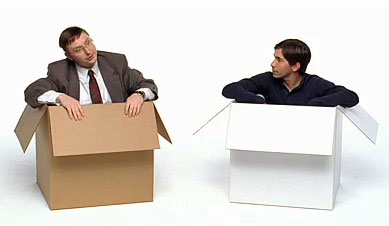
I'll be the first to admit these Apple ads are a trifle on the smug side, if pretty funny.
However, this one, which touts the Macintosh's immediate usability right out of the box, is as true as true gets. I've had the pleasure of taking three brand-new computers out of their packing cases in the last four months: This PowerBook that I'm typing on now (bought for me by my employers; I can't afford that kind of luxury), a Mac Mini for Freddie's birthday present, and an Acer Aspire laptop that I acquired for the local Historical Society, on whose board of directors I sit.
Both Macs were an absolute pleasure to unpack and start for the first time. Apple is so concerned with providing a sleek and seamless user experience that even the packaging the computers came in was very carefully designed. After plugging it in and turning it on, you're presented with a very brief (I think it was five steps) wizard that asks you what you'd like your computer to call you ("Percy Whips," in my case), how you're going to connect to the Internet, whether you'd like to register with Apple, and a few others. Once you're done with this, you're on the Desktop, ready to go. That. Is. It. Firewall on by default, Net connection working, a representative set of iLife apps ready to be launched from the Dock. Go. Have fun.
I really and truly didn't know how good I had it until I unpacked the Acer laptop last night. OK, I won't hold the packaging against them; pedestrian, like opening a box of cereal, but not objectionable. It wasn't until Windows XP reared its ass-ugly face that I started to get that oh-shit-here-we-go feeling. First, you did get something similar to that five-step interview wizard -- but it was conducted in a nasty little underdesigned window, not the welcoming immersive experience that Mac OS X gives you, and while the interview was going on, thousands of other little windows were popping up and disappearing in the background with baffling messages in DOS-ese. Why the hell can't these windows be suppressed if they're giving me information I can neither understand nor act on?
Then I had to reboot. Twice.
When the hullaballoo had died down, I was presented with an incredibly hostile-looking screen that told me I was in grave danger because I had no anti-virus software running. Wow. The first time I boot this thing, and the first thing I'm presented with is a shrieking, blinking-red reminder of the shoddiness and vulnerability of the OS I'm running. (The first thing I saw on my Mac was GarageBand.) I've heard horror stories of Windows machines being booted without virus protection and becoming so polluted with crap that they're unusable within four minutes. So now the first thought I have is that this thing is searching for my house's wireless network (one of the thousand superfluous messages I saw on boot) and it's completely unprotected! Yikes! Better get that digital condom on, toot-sweet!
Whew! There's an icon for Norton Antivirus there on the desktop! Hit it, quick!
"Please insert Norton Antivirus Install Disk."
I mean, WHAT??!?!!?!?! You give me a free copy of Norton Antivirus, and you can't be bothered to install it on my hard drive before you ship it? And while I fumble with the disks that came with the laptop, grubby little hackers in Russia are installing god-knows-what on this computer, which only seconds ago you told me was desperately vulnerable?
Now there's a well-thought-out experience!
Well. So. I got the disk inserted, Norton's installing itself, and then a weird little window pops up in the lower right of the screen. It's not branded, so I can't tell who's trying to talk to me. It says, "We have found two problems. Would you like us to fix them? [Yes] [No]."
I'm beginning to get a throbbing in my temples and a strong desire to go get the vodka bottle. The large Norton-branded window in the center of the screen continues to tell me how many thousands of virus definitions it's loaded and how many thousands are left to go before I'm safe, but as to the nature of these "problems" and exactly what "fixing" them entails it is silent as the grave. I click "Yes" with some reluctance -- I wish they'd provide a "Uh, yyyyees..." button -- and the little window goes away. I'll never know just what the fuck those "problems" were: Massive kernel panic? A corrupted .dll file? Mayonnaise spilled on the disk drive? Got me, Chuck-o. I'm just a dumb Mac user.
So the machine had finally settled down, I was now safe from viruses, my firewall was running. So I decided to check out some of the fab features the Historical Society had paid for. A sort of crab-shaped icon on the desktop advertised itself as "AvRack." I clicked it. And absolutely fell off my couch, roaring with laughter.
 WHAT THE FUCK IS THIS THING?
No, I mean seriously. What the fuck is this thing? I've had to reduce it in size about 20% to make it fit in this column, but the labels and icons are still readable. To judge from the presence of the "Recorder" and "Equalizer" labels on the wings (ears? antennae?) of the thing, it's a media-recording and -playback interface with playlisting capability, but sweet Jesus on a Segway did you ever see anything so unrelievedly, mortifyingly, hilariously ugly? I'm a goddamned grownup, for Christ's sake -- and, presumably, so are the majority of people who can afford laptops -- is the expectation that I am to be somehow impressed by the planet Saturn on a dongle hanging off the default skin of my media player?
OK, OK. That's a cheap third-party dingus placed on the desktop by Acer to fulfill some kind of contractual obligation, and not part of Windows XP. But Boy Howdy is it symptomatic of the Windows world, where cheap, gimcrack -- and above all, butt-ugly -- software abounds. Yeah, cheaper, blah blah. Yeah, more compatible, yadda yadda. Yeah, more games, woof woof (some of us don't give a rat's ass about games). Most of these objections are, if not outright myths, then easily refuted. The truth is that Corporate America forces its slaves to stare, day in and day out, at deeply repellent, hideously badly designed, user-hostile garbage. And because the slaves can't fight back and demand better, because the goddamned IT Department, peopled with Morlocks with Microsoft Certifications in all kinds of drudgery, has a vested interest in keeping the status quo ante.
I'm a Mac. I'm not a PC.
(There, that ought to generate some Comments. Heh, heh.)
(PS: I use an XP machine extensively, although not exclusively, at work. I'm not iggerant.)
Tuesday, September 12, 2006
In Which I Fall Out of Love with the Washington Redskins
I arrived home later than usual last night. Even before saying hello to the family, I ducked into the den to set the TiVo to record the Washington-Minnesota game, which was just starting. I like watching the football with the TiVo; zapping past the commercials is particularly enjoyable, and the halftime inanities whiz by in a lovely blur.
After the house had settled into its evening calm, I snuggled into the couch and waved the remote at the TV. Some five minutes into the proceedings, Minnesota's Brad Johnson completed a long pass to the Washington five-yard-line, and (I think it was) Joe Theismann exclaimed, "Well, it's a good thing the strong safety was there, because otherwise that's a touchdown!
Oh really, I thought. So according to your brilliant, highly paid expert insight, Mr. Fucking Genius Color Guy, absent the only nearby defending player, the man who caught the ball would have actually been able to run unimpeded into the opposing goal? Gosh, I'm sure glad you're here to open my eyes, because I would otherwise have mistakenly believed that the man intended to throw the football into the stands, pull down his pants and fart into a bottle.
The camera panned around FedEx Field, picking out particularly moronic fans with painted faces, wearing ultra-stupid studded rubber chainmail and waving maces as if they believed themselves in a Rob Zombie video, shrieking and leering for the cameras. The Redskinettes pranced lunatically, with idiot grins pasted to their makeup-caked faces, their Barbie bellies, flatter than steel roadplates, flashing in the lights -- you know: eye candy. ABC unveiled its new method of introducing the starting players, which consisted of one of the Neanderthals mumbling the names of the other knuckle-draggers, with thuddingly unfunny humorous asides. This lasted slightly longer than the last Ice Age. Sober-faced and howlingly insincere references were made to the anniversary of September 11. Jamie Fox came into the announcers' booth and just went on and on and on and on and on with self-regarding, Hollywood-Asshole blather, while seeming irritated that play did not actually stop on the field so all in the stadium could bask in the glow of his gigantic, luminescent ego.
And I asked myself the question:
What, exactly, are you enjoying about this?
The cameras then found the owner's booth, and there, sitting with that revolting little gnome Daniel Snyder, was Tom Cruise and his Zombie Stepford Honey, and at that point I suddenly found myself falling, falling, falling out of love with the Washington Redskins.
I've been a follower of the team since 1966, the Lombardi Years, and stuck with them through good times and bad, through George Allen and Jack Pardee and Joe Gibbs I and Ritchie Petitbon, through Sonny Jurgensen and Billy Kilmer, through Edward Bennett Williams and The Squire, through Norv Miserable Turner and Jay Schroeder, Doug Williams, Mark Rypien, Stan Humphries, Rich Gannon, Cary Conklin, Heath Shuler, John Friesz, Gus Frerotte, Jeff Hostetler, Trent Green, Brad Johnson, Rodney Peete, Jeff George, Tony Banks, Kent Graham, Shane Matthews, Patrick Ramsey, Danny Wuerffel, Tim Hasselbeck and Rob Johnson.
And losing to a 2-14 dog-assed Dallas team about 40 times in a row.
And that horrible, awful, atavistic fucking racist fossil of a team name.
And Dan Snyder -- that Tom-Cruise-fellating, imperious Potomac-tree-clearing, filthy-money-grubbing, parking-gouging, traffic-snarling little sack of Napoleonic shit -- finally killed my love for the team.
So long, Skins. It was a good ride. I'll always remember Doug Williams. I'll always hate the dog-assed Cowboys, even if nobody else remembers a time when no one -- that's no one -- wore Dallas apparel in Washington and lived to tell about it.
So long.
Monday, September 11, 2006
We Have Not Gone Forth. We Will Never Return.

"Mason and Dixon's West Line," Aunt Euphrenia setting her Oboe carefully upon the arm of her Chair, "in fact, shares this Quality of Departure and Return, wherein year upon Year, the Ritornelli are not merely the same notes again and again, but variant each time, as Clocks have tick'd onward, Chance has dealt fair and foul, Life, willy-nilly, has been liv'd through.... A drama guaranteed ev'ry time a Reedwoman picks up her instrument, Wick-Wax,-- a Novel in Musick, whose Hero instead of proceeding down the road having one adventure after another, with no end in view, comes rather through some Catastrophe and back to where she came from."The first principle underlying almost all of the world's music is that of going forth and returning. A typical melody begins at a home point, called the Tonic, and it ventures out into a world of musical uncertainty, into conflict and irresolution, a vaguely threatening world of Dominants, Subdominants, Mediants and Supertonics from which, eventually, by one path or another, it eventually resolves back to the Tonic.
--Thomas Pynchon, Mason & Dixon
Here's the simplest possible illustration:
Twinkle, twinkle, little star [going forth]Now, of course, if every song were "Twinkle, Twinkle, Little Star," music would be a damned dull business indeed. And so composers play with this principle, feinting, head-faking, introducing new keys, hinting at foreign tonalities -- anything to disguise the Going-Forth-and-Returning nature of what they're writing. Modernist music that consciously eschews this principle -- out of the composers' intention to break rules, to shock -- repels the ear. If you've ever giggled a bit at a country band stretching a typical "shave-and-a-haircut" song ending to comical extremes, that's the tension that's making you laugh -- not-there-yet... not-there-yet... not-there-yet... shave-and-a-haircut, two bits! (Whew! Home!) Recall the scene in Who Framed Roger Rabbit? where the evil Judge Doom flushes Roger from his hiding-place by knocking the first phrase -- shave and a haircut! -- on the wall; Roger's undoing is his desperate need, deep inside his poor little Toon soul, to finish the phrase -- to accomplish Resolution -- two bits!
How I wonder what you are [and returning].
I've been having an interesting offline conversation with Simon from Homefront Radio about the origins of "Tie Me Kangaroo Down, Sport," and the chat got around to the idea of musical archetypes. "I'm fast coming to the conclusion that every song out there is basically the same song if you break it down to the dominant couple of chords," says Si -- a proposition that has been knocking around in my own head for many years. This is most easily discerned in folk idioms, where that compulsion to disguise or gussy up the Going-Forth-and-Returning movement isn't beaten into the young composer at the Academy or by critics. If you stick to the simple musical rules of folk, eventually (very quickly, in fact) all the possible harmonic progressions -- all the possible "legal" variations on the idea -- are going to be used up.
So you wind up with these archetypes. One I can think of off the top of my head is the "Sixteen Tons" chord progression (i-VII-VI-V), which is so ubiquitous that I can reel it off in my sleep with wide-ranging variations. For some bizarre reason -- perhaps due to its inherent slinkiness -- this progression is amazingly frequently associated with cats: "The Cat Came Back," "Stray Cat Strut," "Cat's Walk." But the fact that we all agree that these chords remind us of a cat is a very important insight into human psychology.
This idea of musical archetypes is immediately suggestive of Joseph Campbell's work, and I'm prepared to assert that just as he applied the idea of Jungian archetypes to mythology, it can just as defensibly be applied to music. When every work-song, every sea-chantey, schottische, reel, breakdown, field-holler, ballad, jody-call and norteño employs the very same emotional shorthand to engage and entertain its audience, clearly something very powerful in the human psyche is being appealed to. Campbell's Hero Myth has a direct and ineluctible analogue in this musical Going-Forth-and-Returning motion I've just been describing: Beginning at home, adventuring out, the encounter of conflict in the form of dissonance and irresolution, and finally the return home. This need for finishing, for ending the story in a satisfactory way, is a deep and abiding one, not just in Myth but in Music too. Something profoundly human is satisfied by that simple two-note sequence: two bits!
Today we're engaged in a form of exorcism. A terrible event struck us five years ago today, and all around me I see the process of mythologizing. We explain September 11 to ourselves as the beginning of something, something that will eventually, as all things must, have an end. We were called to Go Forth on that day, we hear it said, to conquer an implacable evil that attacked us, that will stop at nothing to eradicate us from the earth, and we will Return one day, serene and victorious, to receive our rewards from a grateful world.
Plagal Cadence: Aaaaaaaa-men!
But Myth is not Life. Music is not Life. In fact, we have these things precisely because they aren't Life; they are the means we have of coping with the Bad Shit that Life throws at us. They're our life-preservers, our comfort, our solace.
But they're lies.
In fact, the Going-Forth-and-Returning myth of literature and music that comfort us so never actually happens in Life. There are no beginnings. There are no ends. There are no heroes, and there are no dragons. Nothing began in any true sense on September 11, and nothing will ever truly bring us to some Tonic of resolution. There is only a long, never-ending series of events in sequence -- some foreseeably arising out of causes that happened in the past, some spontaneous and completely random. September 11 was one of the former kind of events, an action by some people who had a grievance and a bitterness so abiding that they justified dying -- and killing -- for it. Their action caused immeasurable grief to countless millions, myself certainly included, but -- and the importance of this is truly profound -- it was not the action of automatons. In fact the September 11 murderers had Myths and Music of their own, and in their own minds they had thoughts of rightness and justice that burned just as brightly in their minds as they do in ours.
Now please. I'm not apologizing for them, or justifying their actions in any way. Their incomprehensibly distorted idea of the worth of a human life is utterly contemptible, and if I could turn back time I'd murder them in their beds without a second thought. But I do profoundly wish, as fervently as I wish for anything, that we could as a species understand just how badly the lies we tell ourselves to escape the reality of injustice and suffering impede the understanding of the truth that this, this thing we have here, this little ball of rock floating in space, is all we've got.
No gods. No saviors. No magic. No prophets. No afterlife. No angels. No saints. No heroes. No going forth and returning. No myths.
What would music sound like then?
Two bits!
Saturday, September 09, 2006
A Career in Porn
[Jeeze, could that Steve Irwin post down there get a little staler? Sorry about that, folks. Got a weird mental thing going, something somewhere between writer's block and performance anxiety, a self-feeding cycle where I'd sit down to try and pooch something out and... Nothing. And, o'course, the next time I'd try to write something, it just got worse. Don't worry, honey, it happens to all men...]
 Early a couple of mornings ago, Wonder Woman greeted me with the not particularly earth-shattering news that Yusuf Islam, somewhat better known as Cat Stevens, had returned to the World of Illusion and was set to release a new album of pop music in November on Atlantic Records. She skipped away and put "Tea for the Tillerman" on the Victrola and went about her morning routine humming along in a transport of cheerful nostalgia.
I've found that as I've aged I've become more tolerant of music I once frankly detested. As I feel myself becoming further and further detached from the dreadful mechanical goo that oozes out from radio and television and movies these days, I welcome Old-Fart-Hood with open arms. I haven't quite reached the point of waving my cane angrily from my gout-stool at the stereo and pontificating about the Good Old Days, but the moment is not far off.
(Still can't be in the same room as Wondie's idol James Taylor, though. Blecch!)
My reaction to her spinning of a Cat Stevens chestnut was fairly typical of my musical mindset these days. Where once Punk-Boy Neddie heard calculation and formula and that stupid and lazy pop mysticism that made the Seventies such an unbearable moment, now I find my cynicism gone, and I simply enjoy his ability to write and execute an evocative melody. Cat had, I'm now free to admit, a way with minor keys -- "Sad Lisa," for example, is nothing short of gorgeous, all that beautiful shifting between between E minor and its relative major G. The song employs archetypal harmonic progressions that wouldn't be out of place in an eighteenth-century Anglican hymn, but that are given new life by the lovely and constantly surprising melody, which is summed up with truly deft simplicity in the harmonic-minor chorus, "Lisa-Lisa, sad Lisa-Lisa." If you want an illustration of the ancient musical principle that minor keys sound "sad" while major keys are "happy," and how a good songwriter uses that fundamental psychoacoustic truism to manipulate his audience's emotions, I'd point you right to "Sad Lisa."
Yes, my toleration surprises me. I'm so forgiving these days. I find myself asking the question, Am I forgiving Cat Stevens, or should he be forgiving me? Of course, he's got plenty of other things to answer for ("Morning Has Broken" and the Salman Rushdie fatwa come to mind), but when it comes to chords and tunes and how they fit together, beef no longer stands between us. Did you know that the Cheryl Crow -- and Rod Stewart and P. P. Arnold -- megahit "The First Cut Is the Deepest" was written by Cat/Yusuf? Well, you do now.
At any rate, I'm going to be fascinated to listen to the new album. Foremost in my mind will be the question, What does 28 years of Islam do to a guy's melodic sense?
By fascinating coincidence, on the same day that Wondie made her discovery about Yusuf Islam's new album, I came across "Harold and Maude" on the Sundance Channel, and I watched the whole quirky thing, humming along to Stevens' prominently featured songs, even grabbing my guitar to dope out the chords to "Where Do the Children Play?" It was, in short, a Cat Stevens kind of day.
Which, I suppose, leads to the question, "What kind of day is it when you watch 'Jesus Christ Superstar' from end to end?" which I did the following night. This sudden two-day immersion in Seventies pop crap led to the following observations:
- Jesus Christ was, apparently, a bit of a butthole.
- I'd hit the 1973-vintage Yvonne Elliman like Barry Bonds on a hanging curveball.
- Like Jesus, Andrew Lloyd Weber is a bit of a butthole.
- The sound-production of the movie is a knee-slapper, with this itsy-bitsy, teeny-weeny little Full Rock Orchestra barely audible on the soundtrack under stentorian singers. I know they wanted Tim Rice's immortal lyrics to stand out, but this was truly ridiculous.
- If they're planning to bring back the Seventies in any form, I want you please to take me out behind the barn and put a merciful bullet through my head.
- The actor who played Peter went on to a career in porn.
Tuesday, September 05, 2006
Crikey! Is This Advert Still Funny?
Well, I think it is, but I'm sicker than most. It's certainly more nuanced, I'll give you that.
At the beach this recent vacation, I had a devil of a time convincing the kiddies that the flat fish they saw wallowing around in the shallows weren't Deadly Poisonous Stingrays. They'd come squealing out of the water like a Great White was on their tails, and I'd try to calm them down by pointing out (with all the confident, casual authority of a Dad Lying His Head Off) that there was a huge variety of rays and skates in these waters, and that the Deadly P.S. was only to be found much farther south -- the Caribbean, perhaps, or Tierra del Fuego -- and that they'd probably been scared by a completely harmless Cow-Nosed Ray or something.
Later, back at the house, I poked around in a book on Atlantic Seaboard marine life we'd brought, and was quite nonplussed to find that in fact Deadly P.S.'s were actually quite common there, and that the object we'd seen in the water may very well have been one. I retreated to the next redoubt, that the Stingray is a meek creature, and that getting pricked is near to impossible as long as you don't bring your clodhopper down on one. The old parental reliable "they're much more scared of you than you are of them" came into play, and we practiced shuffling our feet in the surf, as the book recommended, so as not to go hopping around on stingrays' backs.
Somehow, at any rate, we all survived the Surf Experience, despite one nasty jellyfsh sting suffered by Freddie, and that, I thought, was that.
Now arrives the dreadful news that poor Steve Irwin has departed this vale of crocodile tears, victim of a freak accident -- pierced in the chest by one of those very stingrays I' d been scoffing at for the benefit of the kids in my charge. According to the account linked above, Irwin unwittingly boxed the creature in: ""It stopped and twisted and threw up its tail with the spike, and it caught him in the chest," said [wildlife documentary maker Ben] Cropp. "It's a defensive thing. It's like being stabbed with a dirty dagger."
It's tempting to shake your head sadly and intone, "Live by the dirty dagger, die by the dirty dagger," but Irwin wasn't actually performing his customary schtick when he met his demise -- he taking a break from shooting "The Ocean's Deadliest" and was filming for a children's show.
I do remember a particularly thrilling example of his act from some years ago. On a savannah in southern Africa, we saw footage of saner people evacuating their village, pointing out to the cameras that a black mamba -- truly "the myst dyngerous snyke in the weeeeerld!" -- had been spotted in one of their houses. Irwin, sensing a great bit, went charging into the village, jabbering excitedly. He found the snake, a full-grown beast of truly awful proportion, and began his usual routine: gulling it, calming it, trying to grab its tail in order to lift it up for the camera.
I'd watched quite a bit of "The Crocodile Hunter" show -- the kids were young then, and we watched a lot of that kind of stuff together -- and I'll tell you: I'd never seen Irwin quite this obviously scared. His breathing was shallow, his concentration was absolutely intense, and his voice shook as he swallowed spit. If this was acting -- and quite a lot of Irwin's schtick was acting -- it was damned convincing. The dude was quite plainly, in the parlance, shitting bricks.
It was a good thing, then, that FedEx's services weren't needed during this segment. He and the snake ended up parting ways, if not exactly friends, then at least not in a biter-bit relationship.
We'll miss him and his corny but ultimately beneficial act. Sorry to see you go, Steve, but at least you kicked it doing something you loved.
Now: How am I going to talk those kids back into the water?
Subscribe to:
Posts (Atom)